
There are approximately 1.5 million people with learning disabilities and approximately 700,000 autistic children and adults in the UK.
Autism affects the way people relate to and interact with the world and people around them. Pathological Demand Avoidance (PDA) is a profile that describes those with autism whose main characteristic is to avoid everyday demands and expectations to an extreme extent.
Back in 2020/21, we were approached by a mother of a PDA child who asked if we could provide bespoke Personal Safety sessions for her daughter in the hope that it will help her control her aggression and improve her balance and co-ordination. As well as autism and PDA, the child had ADHD, dyspraxia and kyphoscoliosis.
Our founder Alan Bell, relished this opportunity as he had only recently been diagnosed with Asperger’s Syndrome after many years of suspecting that he was on the autistic spectrum.
Here is a testimonial from the mother following the conclusion of our training:
“The biggest thing for my daughter was the impact on her confidence. She was selectively mute before we started with you, as the social anxiety crippled her. She was totally unable to leave the house on some days and also unable to join in group activities.
Training with The Scottish Centre for Personal Safety definitely opened the door for her. Her communication skills improved as well as her confidence and self-esteem. Her physical coordination was extremely poor beforehand and I really think your training did help with this.
The opportunity to try exercise in a safe place when she thought she was rubbish and worthless was priceless. She was able to follow instruction and demands, as you made it fun and silly. Humour and laughing is the best way to connect with a PDA kid. And you were genuine about it.
It helped with routine and helped with connection with her dad, as she would show him what she had learned after each visit.
Overall, your training had a huge positive impact on my daughter’s mental health. We are able to join other group activities now and I think your training was the catalyst for that. If you knew her before we started with you and see her now – it’s like two different people.
To meet someone like Alan who was also autistic and so funny with his stories, was great for my daughter. She related to his secret weirdness about collecting and acquiring stuff, as he was just describing her. And to be able to hear about all the stuff Alan has done in his life despite his autism, for someone who has been stuck in the house, it’s a big, big thing.
And it was really her only opportunity to exercise. But she didn’t really know she was exercising. Thank you.”
Inspired by this, we have since developed these sessions into our Personal Safety for People with Autism and Learning Disabilities sessions to include people with a variety of learning difficulties and disabilities, not just autism / PDA.
Following more research, we were appalled to find the following statistics, which prompted us to develop our course even further:
• For people with learning disabilities, targeted violence has become routinized (Wiseman, Watson et al, 2021).
• In 59% of disability-aggravated incidents of hate crime, the perpetrator showed prejudice against a person/people with a learning disability (Scottish Government, 2021a).
• Autistic women are three times more likely to experience domestic abuse than their non-disabled peers (Office for National Statistics report 2020).
• 66% of people with a learning disability in Scotland worry about being victims of hate crimes (Coleman et al, 2013).
• Where people with learning disabilities represent more than one protected characteristic, evidence suggests that this presents additional barriers. For example, people with learning disabilities from black and ethnic minority backgrounds are less likely to gain access to support and services than other people with learning disabilities (Mencap, 2006).

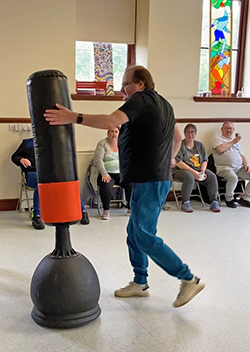
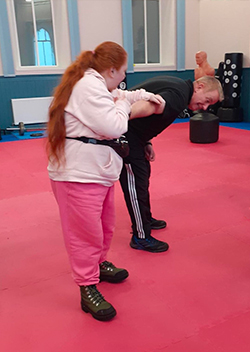
In early 2023, we ran a very successful pilot Personal Safety course for service users of Neighbourhood Networks, an organisation which supports vulnerable adults with learning disabilities, physical disabilities and mental health issues to live an active, healthy life, safely, within their own homes and to be fully involved within their local communities.
Comments include: “We learned some self-defence techniques and how to carry ourselves confidently when and out and about. Alan and the team showed us the moves and helped us learn them ourselves. And the photos show, we learned really well!”
We also ran another very successful pilot course for INCLUDED, a learning & development group service for adults with mild/moderate learning disabilities & Autistic Spectrum Disorder based within Yoker Community Campus.
This generated the following comments:
“Very exciting, trainers very good at explaining things.”
“Loved it, learning how to keep yourself safe, I feel more confident going out.”
“Very interesting, I really enjoyed the pad work.”
“Trainers were brilliant, they took their time and were very good at demonstrating techniques.”
“I really enjoyed whacking the bag.”
As we were developing this course, we ran some individual weekly training sessions for a young man who has Autism and Cerebellar Ataxia. This caused him to experience a loss of balance and coordination, gait abnormality and speech issues, as well as other symptoms such as fatigue and poor motor neuron skills.
Here is a testimonial from his mother following our training:
“I would like to take this opportunity to thank Alan and the amazing team of volunteers at The Scottish Centre for Personal Safety. My son, who has Autism and a neurological condition, attended classes at the Centre over a period of several weeks. During the time he was taking part in the classes, I saw his confidence grow and he started to take an interest in his personal appearance and general fitness as well, seeking other avenues to exercise and improve his physique, in addition to the classes at the Centre. Alan’s personal experience of Autism, and the Centre’s inclusive approach, both in terms of attendees and volunteers, made for an exceptionally welcoming, friendly and unintimidating environment, despite the serious nature of the subject matter. I would highly recommend this service to anyone wishing to learn about self-defence, in fact I do regularly, but also to potential funders, as it’s important that this invaluable service can continue to grow and thrive.”
We were delighted that our work in developing and producing our empowering and life-changing Personal Safety for People with Autism and Learning Disabilities course saw us reach the final of The National Learning Disabilities & Autism Awards 2023 in the category of “Supporting People with Profound and Multiple Learning Disabilities”, the North East / Scotland Regional Final of the Great British Care Awards 2023 in the category of “Outstanding Contribution to Social Care”, and the London final of the Autism Hero Awards 2023 in the category of “Outstanding Education Award”.
And although we did not win, to get to the UK finals for a Personal Safety course we had only recently produced, has been absolutely amazing. We are all extremely proud to have our empowering training recognised at a national level.
Back to top
The Scottish Centre for Personal Safety
Barony St. John Centre
Princes Street
Ardrossan
North Ayrshire
KA22 8DQ
Telephone: 07900 950599
Email: info@scotcps.org.uk
© The Scottish Centre for Personal Safety 2026 Scottish Charity No: SC044042
| Cookie | Duration | Description |
|---|---|---|
| cookielawinfo-checkbox-analytics | 11 months | This cookie is set by GDPR Cookie Consent plugin. The cookie is used to store the user consent for the cookies in the category "Analytics". |
| cookielawinfo-checkbox-functional | 11 months | The cookie is set by GDPR cookie consent to record the user consent for the cookies in the category "Functional". |
| cookielawinfo-checkbox-necessary | 11 months | This cookie is set by GDPR Cookie Consent plugin. The cookies is used to store the user consent for the cookies in the category "Necessary". |
| cookielawinfo-checkbox-others | 11 months | This cookie is set by GDPR Cookie Consent plugin. The cookie is used to store the user consent for the cookies in the category "Other. |
| cookielawinfo-checkbox-performance | 11 months | This cookie is set by GDPR Cookie Consent plugin. The cookie is used to store the user consent for the cookies in the category "Performance". |
| viewed_cookie_policy | 11 months | The cookie is set by the GDPR Cookie Consent plugin and is used to store whether or not user has consented to the use of cookies. It does not store any personal data. |